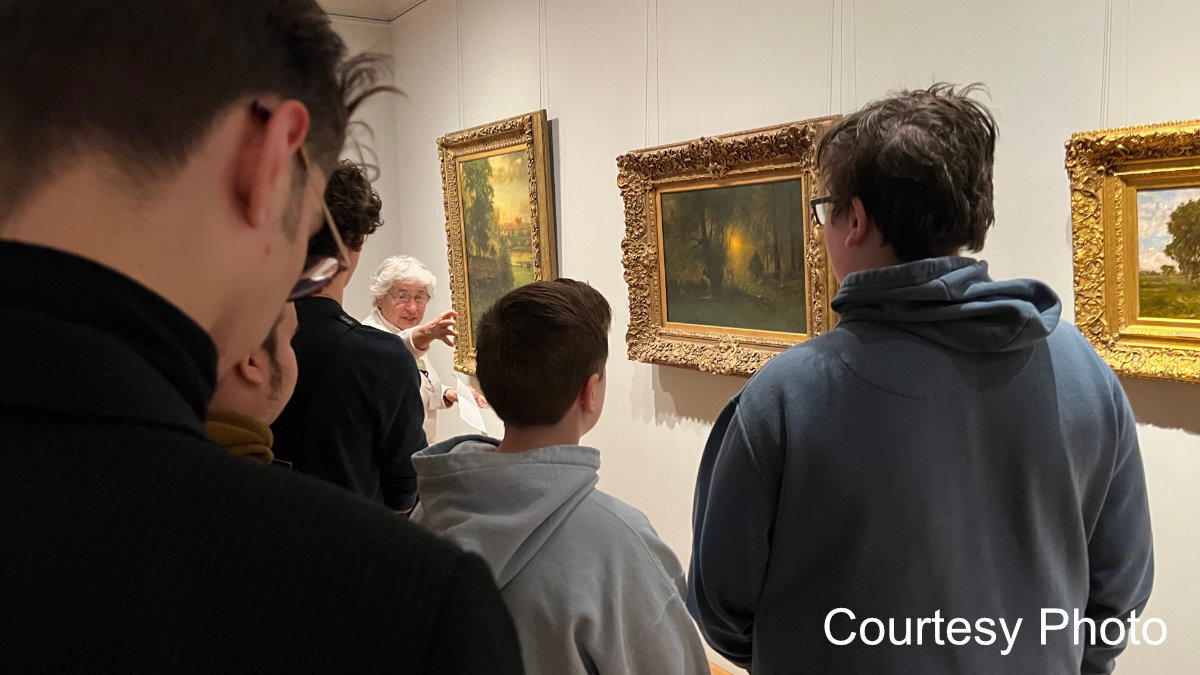
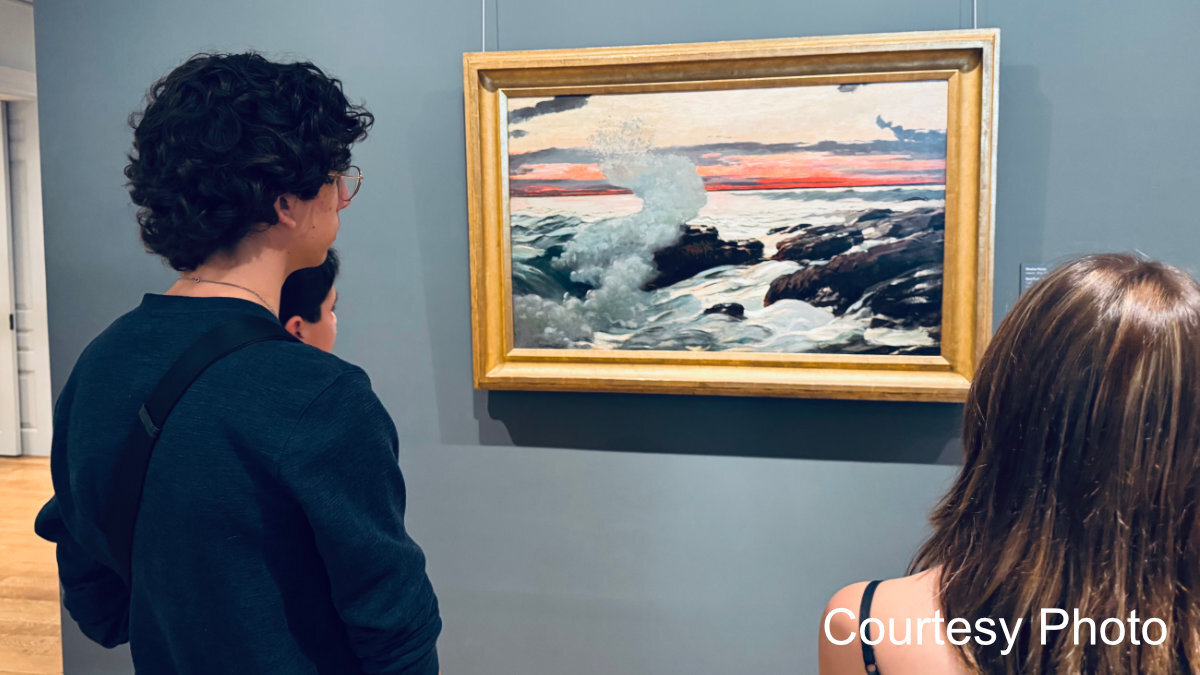
BAAMS students view 'West Point, Prout's Neck' at the Clark Art. The painting was an inspiration point for creating music.
NORTH ADAMS, Mass. — The Berkshires' Academy for Advanced Musical Studies (BAAMS) students found new inspiration at the Clark Art Institute through the "SEEING SOUND/HEARING ART" initiative, utilizing visual art as a springboard for young musicians to develop original compositions.
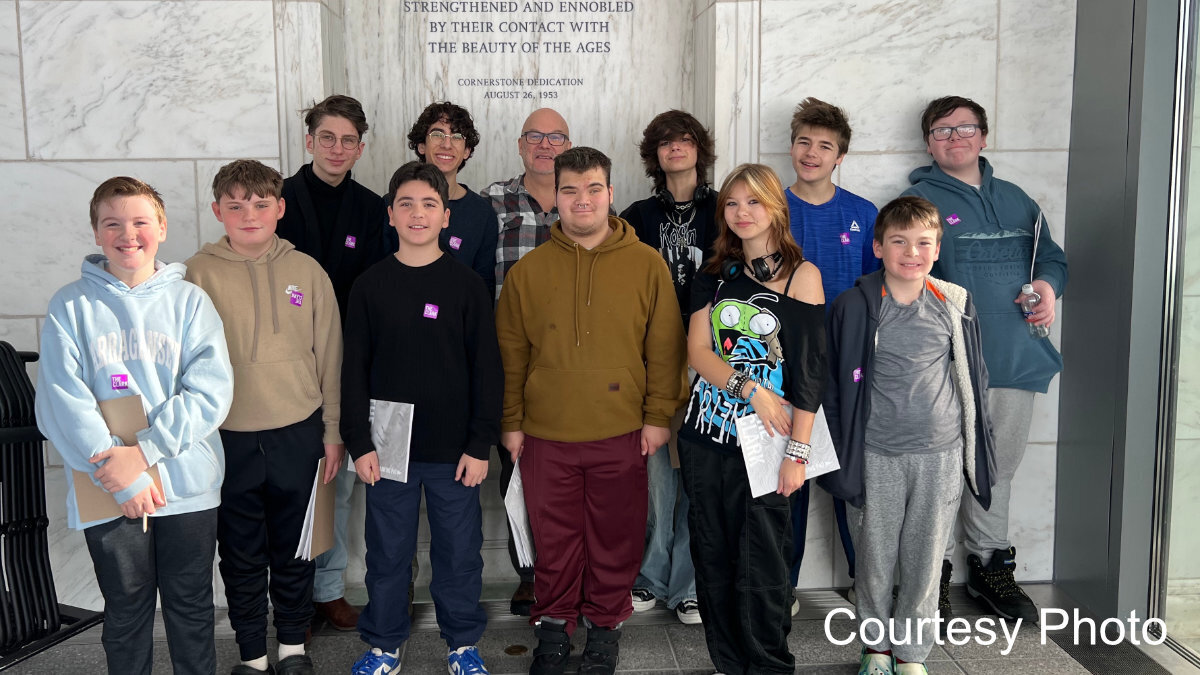
On Saturday, Dec. 6, museum faculty mentors guided BAAMS student musicians, ages 10 to 16, through the Williamstown museum, inviting students to respond directly to the artwork and the building itself.
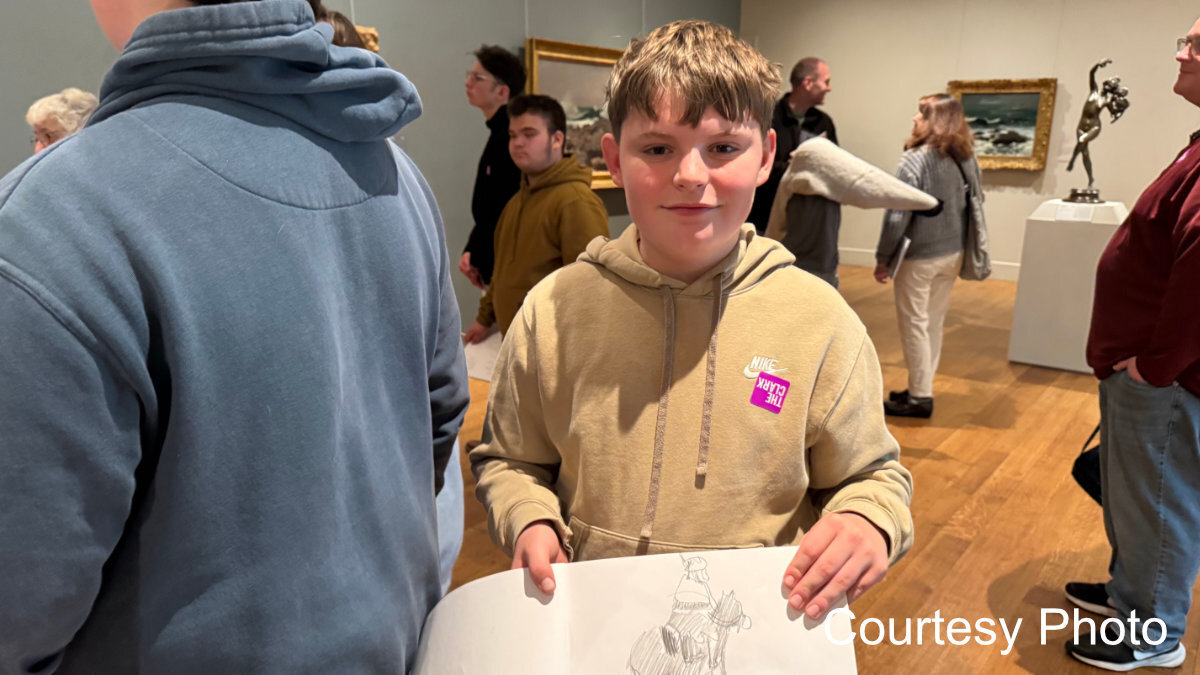
"As they moved through the museum, students were invited to respond to paintings, sculptures, and the architecture itself — jotting notes, sketching, singing melodic ideas, and writing phrases that could become lyrics," BAAMS Director of Communications Jane Forrestal said. "These impressions became the foundation for new musical works created back in our BAAMS studios, transforming visual experiences into sound."
BAAMS founder and Creative Director Richard Boulger said this project was specifically designed to develop skills for young composers, requiring students to articulate emotional and intellectual responses to art, find musical equivalents for visual experiences, and collaborate in translating shared observations into cohesive compositions.
"Rather than starting with a musical concept or technique, students begin with visual and spatial experiences — color, form, light, the stories told in paintings, the feeling of moving through architectural space," said Boulger. "This cross-pollination between art forms pushes our students to think differently about how they translate emotion and observations, and experiences, into music."
This is a new program and represents a new partnership between BAAMS and the Clark.
"This partnership grew naturally from BAAMS' commitment to helping young musicians engage deeply with their community and find inspiration beyond the practice room. The Clark's world-class collection and their proven dedication to arts education made them an ideal partner," Boulger said. "We approached them with the idea of using their galleries as a creative laboratory for our students, and they were wonderfully receptive to supporting this kind of interdisciplinary exploration."
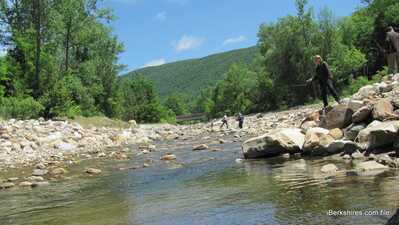
Although a new partnership, BAAMS has done similar projects with students in the past. Boulger recalled a previous initiative where students reflected on the Hoosic River and composed the song "Wise Old Hoosic River."
Boulger said these sorts of programs ask students to engage in the writing process immediately.
"When students respond to art in real-time, they're working more intuitively and spontaneously than they might in a traditional composition exercise. There's no time for overthinking — they're capturing immediate impressions, gut reactions, the way a particular brushstroke or color makes them feel in that moment. This immediacy often leads to more honest, visceral creative work," he said.
He highlighted other important skills students learn, such as active observation, creative note-taking, the discipline of capturing fleeting inspiration in the moment, and most importantly, that inspiration can come from anywhere.
Boulger said students were energized and curious, and he thanked Clark Art docent Ellen Joffe Halpern, who asked questions that prompted creative rather than purely analytical responses.
BAAMS students took their collected thoughts and notes, as well as field recordings and sketches, back to the academy, in Western Gateway Heritage State Park.
Boulger said the group took this raw material and, with the help of faculty, began to solidify musical ideas, develop melodic and lyrical themes, and collaborate on arrangements that honored both individual inspiration and ensemble cohesion.
He added that students approached the process differently. While some were immediately drawn to the narrative of a work of art, others worked in more abstract terms, focusing more on color, texture, and form. Some students wrote lyrics first, while others first nailed down a melody.
"The variety of approaches made the final collaborative work richer — everyone brought something different to the table based on how they personally experienced the art," Boulger said.
After sharing their favorite paintings, students collectively created three new pieces of music inspired by specific works from The Clark: Evelyn De Morgan's "Field of the Slain," Winslow Homer's "West Point, Prout's Neck," and "Sudden Squall at Sea" by François Biard.
Students translated visual art into musical ideas, using elements like specific intervals, the whole-tone scale and other scales, superimposing triads, rhythmic patterns, and instrumental timbres to capture the emotions of the paintings, added Boulger.
What struck him the most was how personal yet resonant the work turned out to be, adding that he could hear the Clark experience in every piece.
"We teach our students to take their life experiences and perceptions and transform them into original music. Our students learn how to really listen and are given the specific musical tools they need to develop their own original music and voice as an artist," he said.
Boulger said it is important to connect young artists to the rich cultural institutions right in their backyard.
"Our students are part of a rich cultural ecosystem in the Berkshires, and we want them to recognize themselves as contributing members of that community," he said. "When they engage with institutions like The Clark, they're not just visitors or consumers of art — they're fellow artists in dialogue with the work they encounter. These experiences help them understand that creativity doesn't happen in isolation. It happens in conversation with place, with the natural and the built world, with history, with other artists and art forms.
"Plus, it deepens their connection to where they live and helps them see the Berkshires as a place that nurtures and celebrates artistic expression."
northadams.com welcomes critical, respectful dialogue. Name-calling, personal attacks, libel, slander or foul language is not allowed. All comments are reviewed before posting and will be deleted or edited as necessary.
Comments are closed for this blog. If you would like to contribute information on this blog, e-mail us at info@iBerkshires.com